
Author: Aurora Vinti
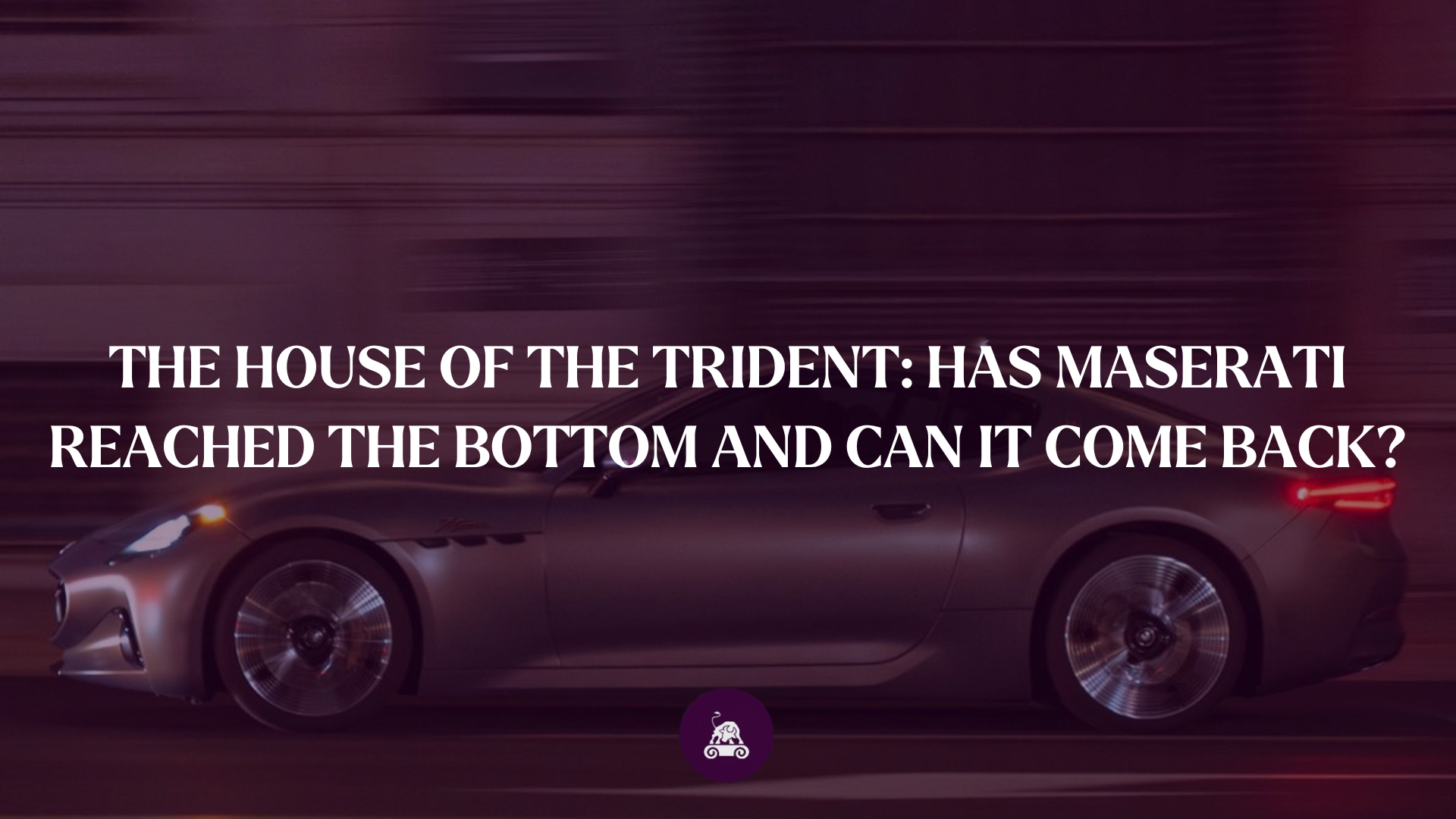
Maserati is an automobile company founded in Bologna in 1914, and throughout the years, it fell in the hands of different owners from Adolfo Orsi who moved the headquarters to Modena, then Citroën, then to Alejandro de Tomaso and finally to FIAT, which opened the doors to the collaboration with Ferrari. Since 2021, Maserati has been part of the Stellantis group.
Maserati became known for its racing, sports and GT cars. During WWI the company produced spark plugs for aircraft engines, and Alfiero Maserati, the founder, drove racing cars for other houses before producing his own, the Tipo 26, and later in 1929 the V4 the most remarkable Maserati of the 1920s with 16-cylinders and with the ability of reach up to 248km/hr. The 8-cylinder 8CM was extremely successful in the racing track thanks to Tazio Nuvolari that won several races driving it in 1933 and 1934.
In 1937 the company was sold to Adolfo Orsi with a significant injection of capital which allowed the continuation of race cars production. The 8CTF won the Indianapolis 500 in 1939 and 1940 proving the overtake of Orsi to be a strategic move.
The house created its first road car at the end of WWII denominated Maserati A6 and ideated by Pininfarina, which was later developed in different versions between 1947 and 1956.
The first GT, the A6 500, was produced in 1948 with 6-cylinders, and in 1957 Juan Manuel Fangio won the F1 World Championship in a Maserati. The first Premier sports car was produced in the 1960s and was the Tipo 60, and the first Quattroporte was in 1963.
Regardless of the great race successes and sales the house fell into crisis due to some debts of Orsi. To avoid bankruptcy, the company was sold to Citroën in 1968. However, Maserati was again unlucky as it was set into liquidation in 1975 due to problems following the 1973 petrol crisis. The crisis caused a rapid decline in demand for sports car and gran turismo and the sole automobile which kept on selling was the Merak, thanks to its small displacement.
In 1975 the ownership was transferred to the Italian GEPI and De Tomaso became the president of the company. The new ownership introduced new models, the Biturbo was abandoned due to its unreliability. In 1984, Chrysler acquired 5% of Maserati, and a joint venture was signed between De Tomaso and Lee Iacocca, according to which Maserati would have built a new model for the American market, composed of Chrysler motor but assembled in Italy. However, the bad reputation of Maserati in America slowed production and only a few models were made.
In 1989 the Gran Turismo was reintroduced through the Shamal projected by Gandini. This model inspired a restyling in the 90s both for the racing sector and the road models.
In 1993 the house was sold to FIAT which became the sole owner that in 1997 sold 50% of the shares to Ferrari also owned by FIAT which later acquire full control and made Maserati its luxury division.
A new era began in 1998 with the 3200 GT with a V8 Biturbo of 3.2liters and a horsepower of 370, the model that was in 2002 substituted by the Maserati Coupé and Spyder which brand a V8 Ferrari.
In 2004 Maserati came back into the motorsport in the FIA GT making its debut in Imola. In 2005 it gets podiums at the American Le Mans Series, however it never wins. It is in 2005 that the ownership shifts back to FIAT, and in 2007 the GranTurismo designed by Paninfarina debuts, and two years later its Cabrio version as well. Following the wake of competitors, it introduces in 2016 its first SUV, Levante, and in 2022 the Gracale.
Finally, in 2022 the brand announced its entrance in the Formula E as a constructor in collaboration with the Monegasque Venturi Racing for the 20022-23 season and the creation of the Maserati MSG Racing Team.
The Stellantis Crisis:
The Stellantis Group is the result of the merge of Fiat Chrysler Automobiles (FCA) and Groupe PSA, joining Fiat, Jeep, Peugeot, Citroën and Opel. The goal of the merge was to create a strong and stable group capable of facing new challenges in the automotive sector, such as electrification and sustainable mobility. The merge was approved by the European Commission in 2020 and was finalized in January 2021 and resulted in the creation of the fourth biggest automotive manufacturer. Stocks began trading in Milan, Paris and NewYork as “STLA”. As of today, Exor, holding of the Agnelli Family owns the majority share 14.4%. The second larges stockholder is Peugeot. The group contains the following brands:
- FCA: Abarth, Alfa Romeo, Chrysler, Dodge, Fiat & Fiat Professional, Jeep, Maserati, Ram, Lancia
- PSA: Citroën, DS Automobiles, Opel, Peugeot, Vauxhall
Subsequently, in 2022, Stellantis acquired the car sharing platform Share Now which was integrated under Free2Move, as well as ai Motive a company which develops autonomous vehicles. And in 2023 it acquired 20% of Leapmotor, a Chinese developer of electric vehicles.
Stellantis faced many challenges, starting in 2021 due to the lack of semiconductors which led to an agreement with Foxconn for the supply of chip. In 2022 the production in France was temporarily suspended for the same reason. In addition, as a consequence of the international sanctions, the group also ceased operations in Russia.
In 2024, the American market was revealed to be the weakest of the Tavares management, sales in the first trimester decreased by 36%. However, sales decreased in every market. In November 2024 the Italian market registered a decrease of 24.6% compared to the same month of 2023. The market share decreased from 29.3% to 24.7%. Vehicle registrations decreased as well in 2024 compared to the previous year. 2024 registered high layoffs on all plans. In the European area sales decreased by 16.7% and market share decreased by 3%. Losses were particularly significant in the electric market which is dominated by Volkswagen and Tesla, the most impacted was the American market which registered in the first three trimesters the decrease was by 17% compared to 2023.
Maserati lived its hardest year in 2024 with Q4 being the worst since 2012, at Mirafiori production fell by 78%, in Modena production of the MC20 plummeted by 79%, and at Cassino, the Gracale dropped by 58%. Overall, Maserati’s production fell by 64% from 27166 units in 2023 to 9760 in 2024. To cap it all, Q4 of 2024 saw a sale of only 2700 units with a decline of 55%. The 2024 overall drop in sales was 57% registered mainly in the American and Italian markets. In the United States sales fell by 37%, in Italy by 42% with only 2242 vehicles sold. This decline was remarked by the combination of the loss of interest in traditional models and the higher prices and reduced range of models.
The crisis of Stellantis influenced other manufacturers whose business depended on Stellantis’ orders: plants were closed in Germany; MA France, a manufacturer and subcontractor of Stellantis, liquidated a plant in Aulnay-sous-Bois, and the metallurgic Eramet announced the suspension of a battery recycling project.
When revising the Stellantis 2024 statements, some results were motivated by a “Deteriorating momentum in the global automotive sector”, and that a main objective is cost-cutting especially when facing the Chinese competitors. As the Stellantis crisis, and the automotive sector crisis, put in doubt the future of many companies, Maserati seems to be one of the most affected as it was speculated the company could be up for sale or even liquidation.
The future of Maserati:
John Elkann, heir of Agnelli, is the president of Stellantis’ BoD, and has acquired an even stronger role after the resignation of Carlos Tavares in December 2024.
Maserati is the only luxury brand owned by the group and Elkann remarked on the group’s effort towards Maserati, and in December 2024 during a meeting with Maserati’s CEO, Santo Ficili, and reflected on the need to rebuild relationships with dealers who are largely unhappy with the previous leadership.
Ficili is not expecting profitability before 2026 meaning 2025 will still be a down year but he is optimistic for the future of the brand and counts on the legacy of Maserati.
Stellantis cleared there is no intention to sell Maserati nor to aggregate it with other luxury groups. They reiterated the commitment to build a bright future for the brand through focusing on the desires of customers and writing the future of mobility. For this reason, the brand is targeting a highly specific audience, implementing expansions initiatives to consolidate its presence in global markets, and strengthening the brand image.
The 2024 loss of 70%, aggravated by the late entry of the brand in the Chinese market, has also drawn Stellantis to cancel some projects, particularly at risk are those related to electric vehicles as they contribute significantly to the costs and don’t see a proportionate gain.
Thus, it is predictable that Stellantis will cut its inventory to boost margins and focus on just a few models to increase sales and reduce production costs. In addition, the company has already begun dropping prices to boost sales.
All we know is that Maserati needs a relaunch plan and 2025 will be crucial for the future of the automotive company.