
Author: Benedetta Sceppacerca
On Wednesday, October 29th, the U.S. Federal Reserve approved its second consecutive interest rate cut. In addition to “the rate move,” the Fed announced it would end the reduction of its asset purchases, a process known as Quantitative Tightening, starting on December 1st.
At first glance the news might seem optimistic because, normally, lowering rates is meant to stimulate the economy and to support employment.
But the broader picture reveals to us a quite complex story.
Indeed, the same Jerome Powell, Chair of the Federal Reserve, raised concerns at the end of the Monetary Policy Committee meeting in Washington, saying that “downside risks to employment have risen in recent months.”
It is therefore crucial to analyze the impact of this highly debated decision, especially since such internal dissent over policy direction hasn’t been seen in years.
BEHIND THE SCENES OF THE RATE CUT:
The decision to cut rates was approved by the Federal Open Market Committee (FOMC) with 10 favorable votes against 2 dissenting: as a result, the benchmark overnight borrowing rate was reduced to a range of 3.75%–4%.
The first dissent came from Stephen Miran, who would have preferred a sharper reduction of about 0.5%. On the other hand, Kansas City Fed President Jeffrey Schmid disagreed for the opposite reason; he preferred the Fed not to cut at all, fearing it could fuel excessive inflation.
It was only the third time since 1990, according to data from the St. Louis Fed, that policymakers had dissented in opposite policy directions, and this is a sign of deep division within the central bank about where the U.S. economy is heading.
THE QT MOVE:
Along with the interest rate decision, the Fed announced that it will end its balance sheet reduction program, a process known as Quantitative Tightening (QT), starting December 1st.
The QT process, introduced after the pandemic, aimed to absorb the liquidity injected into markets during the Covid-19 years. At that time, the Fed had purchased massive amounts of government bonds and mortgage-backed securities to stabilize the economy, expanding its balance sheet from $4 trillion to nearly $9 trillion.
Through QT, the central bank had begun “slimming down” its portfolio, reducing the amount of securities in circulation by about $2.3 trillion. However, in recent weeks, some tension has appeared in short-term lending markets, where banks and companies borrow money for just a few days. Because of this, Powell decided to stop the program, as the Fed is worried that continuing to reduce liquidity could make borrowing too difficult and risk slowing down the entire economic recovery.
“FLYING BLIND” OF DATA:
In its post-meeting statement, the FED committee acknowledged the uncertainty on the rate cut decision brought by the ongoing lack of data. In fact, due to the government shutdown, data collection and reporting have been suspended, and many crucial indicators, such as nonfarm payrolls (which tracks job creation or loss in the U.S. economy, excluding certain sectors) and retail sales, were unavailable.
The only recent data available was the Consumer Price Index (CPI) released last week, showing inflation at 3% (well above the long-term target).
This is the reason why Powell himself admitted that the Fed has been “flying blind,” relying only on partial indicators.
Overall, the available indicators suggested that economic activity had been expanding at a moderate pace and that job gains have slowed this year, while the unemployment rate has edged up but remained low through August. At the same time, inflation remained well above the Fed’s 2% goal and remains somewhat elevated.
Inflation, consumer price (annual %)—US, WORLD BANK GROUP
BUT WHAT DOES CUTTING INTEREST RATES ACTUALLY AND CONCRETELY MEAN?
First of all, lower interest rates make money cheaper. Banks can borrow at lower costs, allowing households and firms to pay less for loans, mortgages, and credit cards. This stimulates both consumption and investment: families gain easier access to credit, while companies perceive it as more convenient to finance new projects.
At the same time, lower bond yields push investors toward riskier assets, such as stocks and real estate, fueling market rallies and a greater sense of wealth. However, prolonged periods of low rates can also encourage excessive risk-taking, creating credit imbalances and potential financial bubbles.
WHY DOES THIS RATE CUT HIT DIFFERENTLY?
This time and in this scenario the dilemma is clear: on one hand, rate cuts boost spending, investment, and employment; on the other, they risk reigniting inflation, which is still above the 2% target.
Job growth is slowing down, which means that companies are hiring less, and although unemployment remains low, the pace of job creation has weakened.
The economy is becoming more fragile, so the rate cut is not a sign of strength but rather a preventive measure to cushion a potential downturn.
The Fed is worried about timing, because if the labor market weakens too much, even looser monetary policy might not be enough to reignite growth.
The outcome is a delicate and halfway balance reflecting the complexity of the current U.S. economic landscape.
WALL STREET REACTION:
At the September meeting, officials had suggested a total of three cuts this year, but the post-meeting statement offered no new guidance on December’s decision. Powell, in fact, disclosed that there is “a growing chorus” among the 19 Fed officials to “at least wait a cycle before cutting again.” Later on, during his October 29th speech, he added, “If you asked me, could it affect the December meeting? I’m not saying it will, but yes, you could imagine that. You know, what do you do if you’re driving in the fog? You slow down.” Powell’s words are a clear call for caution, and, as one could imagine, the reactions on Wall Street were mixed.
Traders often use tools like the C on that same day; during that same day, the probability of another rate cut at the next meeting dropped sharply from 90% to 67% in just a few hours.
With respect to stocks, they initially rose following the decision (since lower rates stimulate growth and investment) but turned lower after Powell’s comments. Major indexes (the Dow Jones, S&P 500, and Nasdaq) eventually recovered later in the day, possibly due to clarifications from Powell and a calmer, more rational market response.
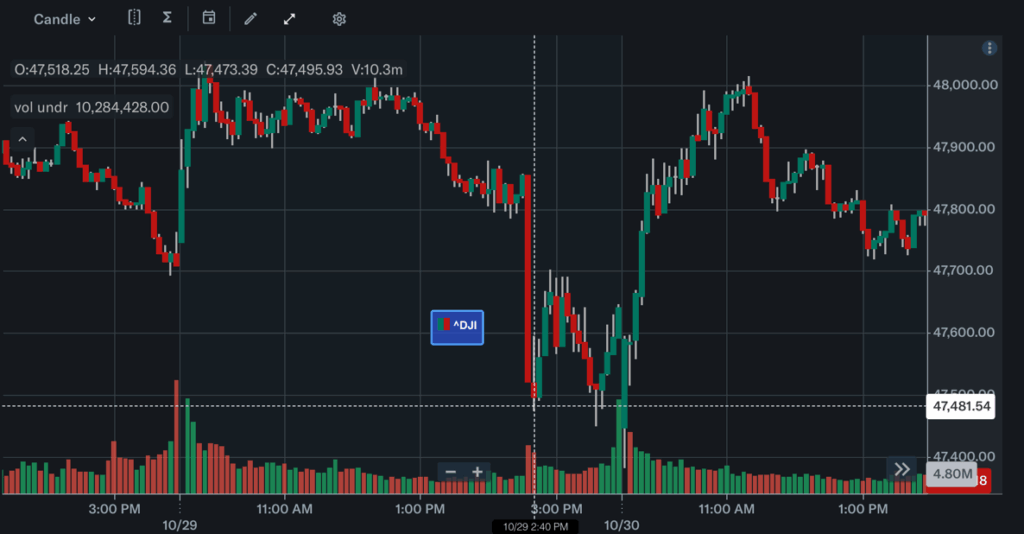
Example of DOW JONES candle volume OCTOBER 29th (Powell speech at 2:30 E.T., evidence of 2:40 DOWN PICK, with subsequent recovery)
CAUTION AS THE GUIDING LIGHT
Powell’s message is clear: the Fed does not want to act impulsively. After two consecutive rate cuts, the priority is now to observe how the economy reacts, especially amid incomplete data.
In other words, Powell is saying, “We’re lowering rates to help the economy, but don’t mistake the reduction in rates for a sign of strength.”
These policies are a sign that the Federal Reserve is trying to keep its hand steady in an ocean of uncertainty, balancing the risk of persistent inflation against the need to sustain internal growth. History shows that the Fed’s decisions shape not just markets but global confidence in the U.S. economy. And today, more than ever, that confidence rests on balance and cautiousness. But will the Federal Reserve’s cautious approach be enough to sustain growth without reigniting inflation?