
Author: Aurora Vinti
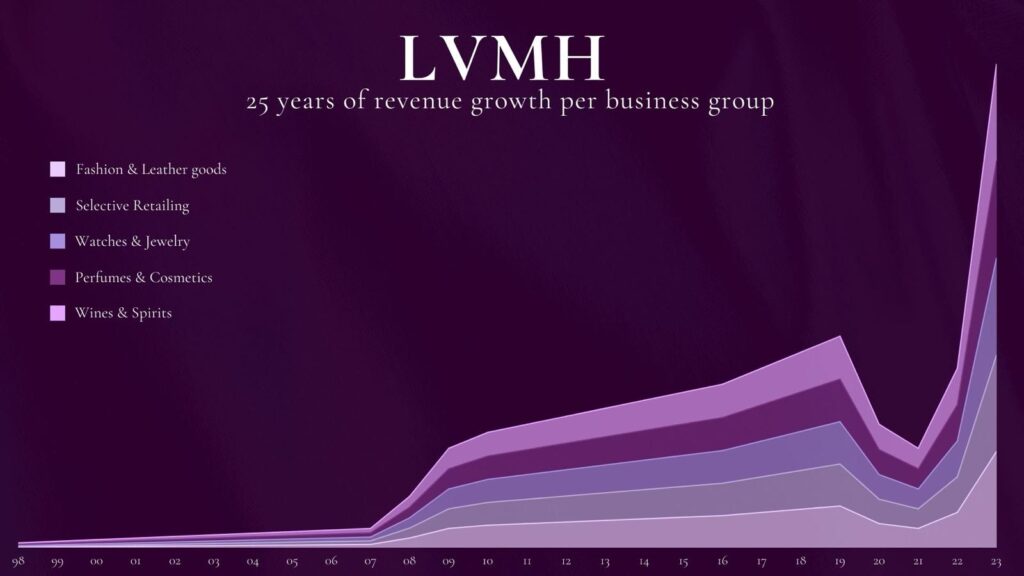
LVMH: a giant built on acquisitions
LVMH, the global leader in luxury goods, was formed in 1987 through the merger of Louis Vuitton and Moët Hennessy. Since then, Bernard Arnault has expanded the group into a powerhouse, acquiring 75 Maisons operating across six distinct sectors through a series of intricate mergers and acquisitions (M&As). Over the past four decades, the group has completed 43 acquisitions, with an average deal size of $5.5 billion each. This strategic expansion has allowed LVMH to both vertically integrate and horizontally diversify, acquiring brands that span a wide range of sectors.
Today, LVMH’s six core business areas are: Wines & Spirits, Fashion & Leather Goods, Fragrance & Cosmetics, Watches & Jewelry, Selective Retailing, and Hospitality. The group is a symbol of elite luxury, known for its commitment to innovation, selective distribution, and the highest standards of craftsmanship. The brand’s geographical reach and strategic acquisitions have ensured that LVMH maintains its leadership in the luxury market, attracting a wide consumer base across multiple price points.
The strategic approach: geographic and sectoral balance
LVMH’s success lies in its strategic geographical balance and all-encompassing presence in the luxury sector. By acquiring established European brands, many of which were family-owned businesses, LVMH has helped these companies thrive in an increasingly competitive global economy. Under LVMH’s stewardship, many of these brands have experienced a renaissance, benefiting from world-class designers, top-tier operational teams, and the group’s extensive resources.
LVMH’s acquisition strategy was focused on regrouping and internationalizing European companies, with a particular emphasis on French family-owned businesses. This approach has allowed the group to capture demand across various sectors, from fashion to spirits to hospitality, while maintaining a consistent high-end image. The group’s decentralized organizational structure has facilitated rapid decision-making and enabled each brand to respond autonomously to consumer demands, ensuring that every acquisition benefits from the group’s vast expertise without losing its individual identity.
Operational excellence and synergies
LVMH’s operational model has been vital to its success. The group’s decentralized structure allows each brand to grow organically, promoting modernization and innovation in product design, and respond autonomously to consumers’ expectations through rapid and effective decision-making processes.
Vertical integration ensures excellence throughout the supply chain, from manufacturing to retail, while the group’s selective retail strategy ensures the luxury experience is maintained at every touchpoint through complete control of the brands.
The synergies created by sharing resources across brands have not only respected the individual identity of each Maison but also strengthened them collectively. This approach has helped preserve the historical legacies of many brands, while also encouraging the pursuit of distinctive identities and sustainable practices.
LVMH’s commitment to sustainability has also been a key focus, with the company establishing an environmental sustainability department as early as 1992, following the Earth Summit in Rio de Janeiro.
Diversification: the key to success
One of the most important factors behind LVMH’s remarkable growth is diversification: geographical, sectoral, and within its business operations. The group’s broad range of brands, from the iconic Louis Vuitton to the newly acquired Off-White, ensures that it has a presence in nearly every segment of the luxury goods market. This diversification has allowed LVMH to maximize sales and profits across a variety of product categories, appealing to different customer demographics.
The group’s geographical reach has also played a critical role. By expanding the availability of its products in stores worldwide, LVMH has been able to increase its customer base and extend its dominance in the luxury sector.
Key acquisitions
LVMH has made numerous high-profile acquisitions over the years, each strengthening the group’s position in the luxury market. Some notable acquisitions include:
1988-89: Acquisition of Givenchy and Parfums Givenchy, founded in 1952 by Hubert de Givenchy and famous for its association with Audrey Hepburn.
1992: LVMH becomes one of the first luxury groups to create a dedicated department focused on environmental sustainability.
1993: Acquisition of Kenzo and Berluti, with Kenzo founded in 1970 by Kenzo Takada.
1994: Acquisition of Guerlain, founded in 1828 and renowned for its perfumes, skincare, and makeup.
1996: Acquisition of Loewe and Celine, two prestigious brands with a history in leatherwork and fashion.
1997: Acquisition of Sephora and DFS, specializing in beauty and luxury travel retail.
1999: Creation of a Watches & Jewelry division, including acquisitions of TAG Heuer and other notable watch and jewelry brands.
2001: Acquisition of Fendi, founded in 1925 in Rome, enhancing LVMH’s presence in luxury fashion and leather goods.
2011: Acquisition of Bulgari, marking LVMH’s serious entry into the luxury jewelry market.
2020: Acquisition of Tiffany & Co., further bolstering LVMH’s presence in the high-end jewelry sector.
These acquisitions, combined with organic growth, have allowed LVMH to continuously expand its portfolio and maintain its leadership in the global luxury market.
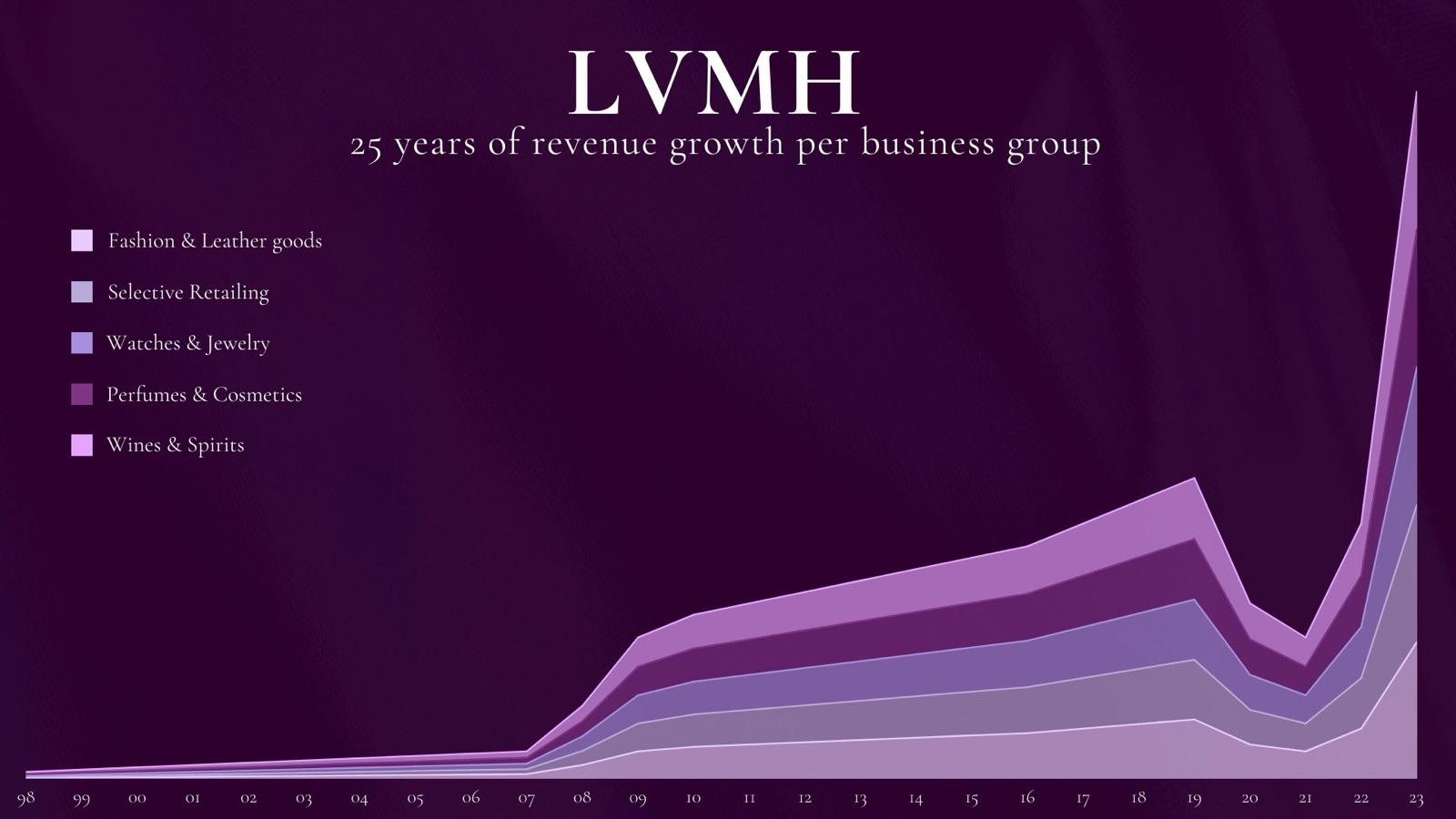
In 1989, following a hostile takeover Arnault ousted Recamier (CEO of Moët Hennessy) and became the CEO and chairman of the merged group LVMH. Throughout the years, as displayed above, Arnault secured the growth and competitiveness of the group through a series of acquisitions and registered a 500% revenue increase from 2005 to 2022, and in the same year announced annual profits exceeding 20$B.
Out of all the acquisitions, Tiffany was the biggest one surpassing the 13B of Dior in 2017, and with a positive market response with an increase of the Euronext Paris of 2.6% at €515,30 per LVMH stock.
This acquisition brought LVMH to be the most valuable group in Europe.
When analyzing LVMH it stood out, among its weaknesses that the group had a fierce competition of much popular brands and unlike the competitors was less involved in the jewelry market. The acquisition of Tiffany was able to change this perspective and raise LVMH to one of the leaders in the jewelry brands.
The Tiffany Acquisition: a game-changer
The 2020 acquisition of Tiffany & Co. for $15.8 billion was a landmark move for LVMH. Tiffany, a storied American brand with a rich legacy in luxury jewelry, was previously considered a missing piece in LVMH’s portfolio, which had a relatively limited presence in this segment. The acquisition helped LVMH address a key weakness: its relatively smaller footprint in the highly competitive jewelry market compared to rivals like Richemont (Cartier) and Kering (Gucci).
Following the acquisition, LVMH made key executive changes, appointing Anthony Ledru as Tiffany’s CEO, and Alexandre Arnault (son of Bernard Arnault) as Executive Vice President of Products and Communications. The move further integrated Tiffany into LVMH’s luxury ecosystem, which already included Bulgari, TAG Heuer, and Hublot in its Watches & Jewelry division.
The Tiffany acquisition also provided LVMH with a stronger foothold in the U.S. market and gave the group an opportunity to modernize the brand to appeal to younger, more diverse luxury consumers. The iconic “Landmark” store in New York underwent a major renovation, becoming a flagship for the brand’s new direction. Tiffany’s wide range of products and pricing has also allowed LVMH to reach a broader audience while maintaining the luxury cachet of the brand.
Post-acquisition success and continued growth
The integration of Tiffany into LVMH’s portfolio has proven successful, contributing significantly to the group’s record revenues in 2023. LVMH posted a 13% increase in revenue, reaching €86.2 billion. This was driven by strong performance in the Jewelry & Watches division, particularly from Tiffany and Bulgari.
In Bernard Arnault’s words, “Our growth strategy, based on the complementary nature of our businesses, as well as their geographic diversity, encourages innovation, high-quality design, and retail excellence.” This holistic approach has not only secured LVMH’s position as the world’s leading luxury goods group but has also positioned the company for continued success in the future, with a strong focus on sustainability, innovation, and global leadership.
LVMH is confident in its ability to drive growth, not just through acquisitions, but through the strength of its brands, its commitment to quality, and its ability to innovate in the luxury market. The partnership with the Paris 2024 Olympic and Paralympic Games promises to further elevate the group’s global standing and reinforce its reputation for excellence.
Recent turbulences
Despite an overall positive outlook, LVMH’s staff is expressing concern. Representatives report that “for weeks, handbags have been piling up in our warehouses, unsent, and management is forcing us to take our vacations now to reduce production.” This follows a significant decline in revenues and profits, primarily in the leather goods sector, which has been hit hardest.
LVMH posted a 3% drop in sales during the first quarter of 2024, with further declines of 5% in the subsequent two quarters, according to data released on October 15. Analysts are particularly concerned about the leather goods division, which accounts for nearly half of the company’s global sales and three-quarters of its operating income.
This marks the first downturn for the French luxury group since the COVID-19 pandemic in 2020. However, LVMH remains confident in its recovery, stating that it will continue to focus on enhancing the desirability of its brands through a commitment to authenticity and quality.