Author: Benedetta Sceppacerca
When thinking about today’s most fascinating and widely used technologies, Artificial Intelligence (AI) inevitably comes to mind. AI is evolving at an extraordinary pace: according to Sam Altman, CEO of OpenAI and one of the leading figures behind the AI boom, humanity could be close to successfully building an artificial superintelligence.
In one of his blog posts, Altman mentioned that “robots are not yet walking the streets,” but then he added that “in some big sense, ChatGPT is already more powerful than any human who has ever lived.”
While we may still have to wait to see robots drifting around the streets, many companies have already begun integrating AI technologies into their daily operations to enhance performance and efficiency. However, this raises an important question: do AI technologies bring only benefits, or do they also come with drawbacks when it comes to improving a company’s profitability and long-term growth?
AI ADOPTION AS A BUSINESS STANDARD: WHAT IS THE FEEDBACK?
AI advancements are happening at lightning speed, as demonstrated by the huge investments being made in the field: in May 2025 OpenAI announced a $6.5 billion acquisition deal aimed at building “a new generation of AI-powered computers.”
Generally speaking, according to Workday’s research, 82% of organizations are expanding their use of AI by investing in its technologies, or 96% if you include testing it on a small scale to determine its effectiveness. On the other hand, only 1% of companies don’t have any plans to use the technology.
Workday also found that three-quarters of humans are pleased to work alongside AI agents and receive recommendations from them. Interestingly, 63% said that they even prefer working for companies that invest in AI, believing it provides them a competitive edge, particularly among younger people.
However, this enthusiasm slightly fades when AI acts as a manager or has to make certain decisions. Data reveal that, out of 10 respondents, 7 said they aren’t comfortable with AI managing them, 6 said they aren’t comfortable with AI making critical financial decisions, and 76% said they would be uncomfortable with AI operating in the background without their knowledge.
Respondents were more open to AI handling IT infrastructure, technology provisioning, and skills development, but preferred humans for recruitment, pay, conflict resolution, risk management, and legal compliance.
WHEN THE HYPE MARGIN FADES:
Despite the optimistic promises from corporate leaders about AI’s potential to increase efficiency, most companies are not yet seeing a return on their AI investments. Quite unexpectedly, there’s been a shift in sentiment around artificial intelligence: while it’s too early to declare 2025 the start of the “AI winter,” or the “AI correction,” or the “AI bubble burst,” recent industry slip-ups are forcing investors, businesses, and customers to be more concerned.
Pitfalls include:
- Meta, which was once offering $100 million signing bonuses to attract top AI talent, has now frozen hiring and is reportedly considering cuts to its AI division.
- Sam Altman is explicitly referencing the word “bubble” in media interviews, comparing the market’s reaction to AI to the dot-com bubble in the ’90s, when the value of internet startups soared before crashing down in 2000. “When bubbles happen, smart people get overexcited about a kernel of truth,” Altman said. “If you look at most of the bubbles in history, like the tech bubble, there was a real thing. Tech was important. The internet was a really big deal. People got overexcited,” he added.
- MIT (Massachusetts Institute of Technology) research reveals that 95% of generative AI pilots fail to deliver measurable returns on investment.
This is creating what experts call a “GenAI Divide” between companies stuck with basic chatbots and those building smarter and learning-based systems.
WHY AI IS NOT PAYING OFF:
The problem isn’t the technology itself, but rather how companies are using it. “There has been this general promise of, ‘Hey, you’ll just plug in the model … and everything will work,” said Jason Droege, CEO of startup Scale AI. “The reality is a little bit different.”
Popular tools like ChatGPT and Copilot have been celebrated for improving productivity, but they are less successful at increasing corporate profits: “I think one of the misunderstandings is that AI is this magic wand or that it can solve all problems, and that’s not true today,” he said. In other words, companies that fail to see a return on their AI investments are often trying to apply the technology to the wrong kind of problem, according to Droege.
Reports show that ChatGPT struggles with context retention and doesn’t learn or evolve, repeating the same mistakes, making it unsuitable for mission-critical tasks: “It’s excellent for brainstorming and first drafts, but it doesn’t retain knowledge of client preferences or learn from previous edits”.
In short, this means that organizations fail not because of model quality or infrastructure issues, but because AI tools forget everything after each conversation and can’t adapt to a company’s specific needs.
MIT also found that much of the money invested in AI ends up misallocated. According to the report, most companies pour their AI funds into sales and marketing, but the real money-savers come from automating the “boring tasks” where humans are “slow or inconsistent or error prone” (i.e., automating paperwork and summarizing or editing many pages of documents, processing invoices, and handling routine administrative work).
But there is another common mistake: companies try to do too many things at once instead of fixing one problem well, relying on special “innovation labs” and AI teams instead of empowering the people who actually understand the workflow.
As MIT put it, “Rather than relying on a centralized AI function to identify use cases, successful organizations allowed budget holders and domain managers to surface problems, vet tools, and lead rollouts.” In other words, the people closest to the work know best what they need, not a distant AI innovation team.
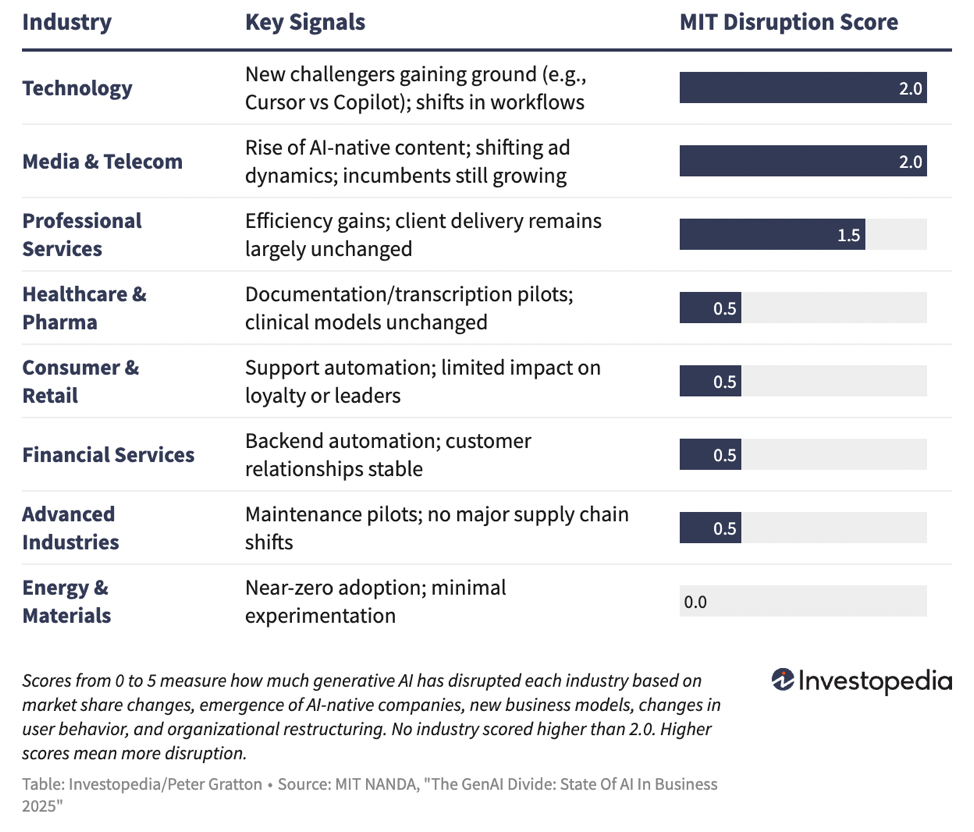
To solve AI’s limited adaptability, many companies are spending millions on proprietary generative AI systems supposedly tailored to their in-house processes.
But is this approach really working? Data suggests otherwise: only 5% of customized enterprise AI tools reached production, with the majority failing because of fragile workflows, lack of contextual learning, and poor alignment with day-to-day operations.
CONCLUSION:
THE BOTTOM LINE
Most AI companies are struggling not because the technology is bad, but because it is not yet sophisticated enough for large-scale business use, and because many organizations are failing to adapt their strategies accordingly. Setbacks are part of every technological revolution, but they often mark the beginning of real progress. As innovation accelerates, the race is no longer about who adopts AI first: it’s about who learns how to make it truly work.
SOURCES:
- MIT. “The GenAI Divide: State of AI in Business 2025.”
- https://www.investopedia.com/why-ai-companies-struggle-financially-11795162
- CNN Business